


I was 48 when I started my formal study of philosophy. During my first, 25 year, career as an engineer, I had continued to live out my pubescent fascination for philosophy by reading many books, mostly primary literature written by canonic philosophers: white men who were long dead. I was the typical white Western cis middle-aged and higher-income male. I could still honestly doubt whether the West’s contribution to the world outweighed the horrors inflicted by colonialism. Just as naïvely as I could deplore the many woes of Christianity, but at the same time wonder - on behalf of Muslim women - how they should dress. The list of my patriarchally universalist doubts is endless, but these examples should suffice to show I strongly needed something strong to wake me from my dogmatic slumber.
At this point of the post, you can still scratch your head wondering whether I write all this with my tongue deep in my cheek or whether I’m seriously making fun of my old self. I shan’t keep you in suspense: I proudly announce that, around my 54th birthday, I was declared to be wide awake, obtaining a PhD in philosophy with a dissertation on Tourette’s, neurodiversity and autism. Undoubtedly, most of my fellow white Western cis men will find it typical of the woke academy to force me into breaking ranks with them. I, on the other hand, just find it ironic that the metaphor of ‘awakening’ seems reserved by them to a single - Kantian - point in history as if all dogmatism was - then and there once for all - dispelled, such that humanity would henceforth never ever feel any sleepiness whatever. As they should find it alarming to feel the need to close ranks around a fixed idea, given dogmatism essentially is protecting the superiority and the purity (shorter: supuriority) of whatever creed over and above any criticism.
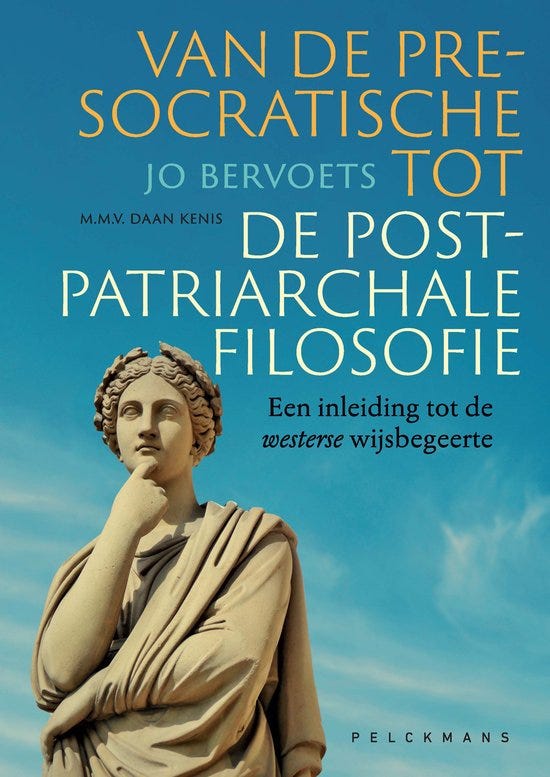
This post tells the story of my soft awakening: how - in those six years - I fell from my belief in the Enlightenment, wrote an introduction to Western philosophy handbook inspired by my apostasy (appropriately entitled: “from presocratic to post-patriarchal philosophy”, unfortunately not yet translated) and - most importantly - how and where one finds said soft awakening. Most importantly since it is an all too human tendency to doze off, and one should therefore have methodological assurance to in fact be able to doze off without risking to live the nightmare where one believes one has become a Guardian (of Truth and Science). Since I genuinely care for people who look like me, I write this to give them an off-ramp from their dogmatic slumber by proposing a new adage for them (entirely in the original Enlightenment spirit): Audire Aude!
(continued below cover of my introduction to Western handbook philosophy)
Minorization
To start the story: why did I start formally studying philosophy at 48? Because, as said, it was my pubescent obsession, but mainly because at that specific time I simply had no other choice. After a short and somewhat pathetic attempt at starting my own start-up (no white male cliché was spared me), I completely burnt out. There I sat on the couch of a psychiatrist who voiced her strong hunch that I was autistic and had the audacity to take my wish to file for euthanasia seriously. It was that audacity that allowed me to take seriously her request to first try to find a new sense of purpose. Hence philosophy and, racking up another cliché for this autistic with a late diagnosis, researching sense or nonsense of the question “What is autism?”.
You will have to find my answer to that question elsewhere. In this post I will focus on something else: that I - the very typical embodiment of the dominant white cis … male majority - realized I also formed a part of a - quintessentially atypical - minority. More specifically a minority that, even if they benefit from a privilege of convincingly being able to wear the mask of the neurotypical majority, finally burns out because of a slow fire inside: the additional energy required to pass for what the powerful self-evidently take for normal. This realization left me only two options: put up a wall of enlightened indignation (the world is not yet ready for my supreme X-factor like rationality!), or ask myself how it feels not to have the good fortune of being accepted in the majority view as capable of a fully rational way of life. I chose the second option because it is on the left and therefore right. This piece is consequently and essentially a choice to find and experience one’s own minority to value the insights of other minorities; insights from those who don’t have the privilege of privilege; therefore do have the merit of survival.
The post- in apostate
What did I learn by listening to philosophy written by minorities? That each minority has something significantly new to add to philosophy, such that philosophy can never be universal or completed. And, hence, that the compulsion of the Enlightenment to - once for all - transcend the subjective and the situated and fix final rules for what can be considered rational - and what not -, is arrogant and destructive of knowledges (yes in the plural). Whether it is in feminism or postcolonialism or disability studies (all of the studies so reviled by canonical philosophers), it’s the Enlightenment and modernity that get critiqued. Why? Because it is clear that the Enlightenment canon pontificates that scientific objectivity is only reachable by abstracting from specific standpoints or perspectives. The most that can be reached from this modern, Western perspective is a benign and charitable sympathy for minorities with a comorbid, paternal disdain for the very idea that they might contribute anything philosophically interesting.
In essence, Kant’s Enlightenment was a critique of a similar (religious, feudal) slumber in which other perspectives were at most tolerated. A quote that would fit his ethos of awakening would go like this: “The master’s tools will never dismantle the master’s house.” Alas, after awakening always eventually comes, for us mortals, a new dozing off. Who now rules the world as a lord and master? Who forces their tools of abstraction and of objectivity on everyone that has been oppressed throughout our modern history? I will complete the above quote of Audre Lorde, Black feminist philosopher-poet: “They may allow us to temporarily beat him at his own game, but they will never enable us to bring about genuine change.” As homework you can read her book carrying the title of the first part of the quote. My point is that the Enlightenment denies the very possibility that post-modern philosophy could be possible, whether it is postcolonial or postpatriarchal. At that time apostasy becomes the only rational option if we do not want to get stuck - as we are stuck - in continual competitive warfare.
The post- in Compost
Apostasy is also the only rational options because it sets science in motion, away from dead-end abstractions such as “the gene for X”. Like the gene for autism I do not carry for the simple reason it does not exist. It is professor Kristien Hens who led me to the new biological insights that refute what is effectively baptized “the central dogma“ of molecular biology (Dawkins remarketed it as “The Selfish Gene”). Biology was woken up by biologists like Barbara McClintock and Lynn Margulis from the slumber where genes only acted like little modern macho men competing to come out on top. And the new genetic reality was one where cooperation (between genes, between organisms, …) also finds its place.
All this is in line with the insights of feminist philosophy of science that reality is not exclusively one where people are pitted against each other and have to fight nature. No, reality is also one where people cooperate to care for one another and nature cares for us if we let it. Anti-dogmatic awakening is the slow realization that fighting for social justice is not something separate from science in the way that the Enlightenment has separated ‘is’ from ‘ought’. The slow realization that if white men aren’t entitled to use the rest of humanity as they see fit, maybe humanity should not be entitled to extract from the rest of the world whatever will increase our fitness. Instead of seeing us as at the top of the ecological pyramid, we can see ourselves as mere compost that has to do its stinking best to keep things lively (and hence diverse!). The research group of Prof. Hens - my school for awakening - is therefore aptly named the Compost Collective.
No post- without pre-
This story isn’t complete without pointing to the fact that one of the things that come to light in ecological philosophy is the importance of tradition. The long tradition of microbes that, all this time, take care of ensuring we have an oxygen-rich atmosphere. But also traditions that are at the heart of non-Western or indigenous philosophies. A whole suite of traditions carrying over practices to new generations, generations that adapt these practices to their ever changing realities. Well, my tradition (and this is so for most people reading this, especially the ones who resemble me most) remains that of the Enlightenment. My apostasy is therefore not very fanatic. Hume nor Kant get a statue from me, but neither should they be burned at the stake nor their books thrown onto the pyre.
Traditions are important. Traditions can also be suffocating. They need to be carried over in a non-dogmatic way and therefore need to allow radical critique. Being critical is as important for cultural oxygen as microbes are for molecular oxygen. Maybe it did not pass unnoticed for the attentive reader that coupling Audre Lorde to the spirit of the Enlightenment is also, implicitly, critical of Lorde. Even when we cannot only rely on the old master’s tools, why would we discard them on principle?
My invitation for schools for soft awakening is then not to just discard the old master’s tools (just like we moderns should not just have discarded religion!), but rather to build on it. Just like Charles Mills did in his Black Radical Kantianism, we need to know not only the limitations of the old tools but also their continued added value. For instance, we want to keep modern science, but only if it is a science that remains curious and is not lulled to sleep because of its technological success. Just like we should have kept a basic respect for religious traditions that still cared about the world instead of having become frozen over in their power-hungriness. This means that it is still good to start with the presocratics because possibly Socrates himself threw away quite some tools from our own indigenous cultures that we now direly need in our dire times (and that we now start to rediscover in the indigenous philosophies of other cultures).
Conclusion: Audire Aude
Kant thought we had to dare to think for ourselves. That is fine as far as it goes. But it goes too far if we start to believe that what others think doesn’t matter. Then we need a complementary adage to “Sapere Aude” not to go off our - ethical guard - rails: dare to listen (“Audire Aude”). Because to think one has a monopoly on truth is the thought that comes right before dozing off.